FARMERS ENCOURAGED TO EMBRACE THE NATIONAL AGRICULTURE INSURANCE SCHEME (NAIS).
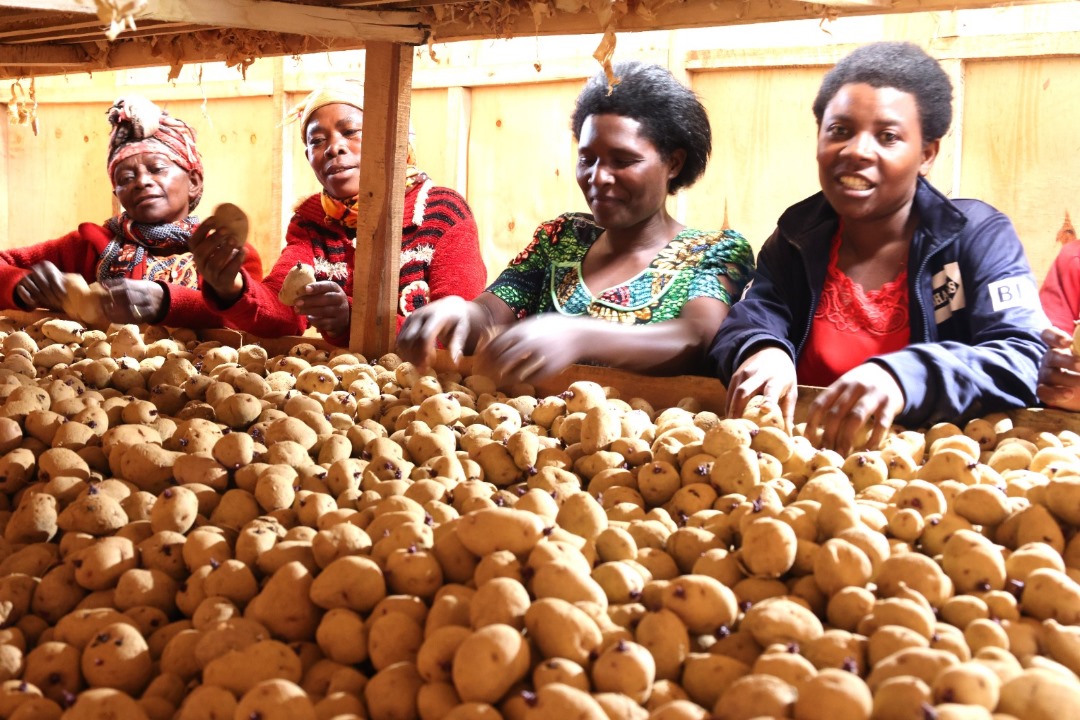
In a significant move to strengthen the resilience of Rwanda’s agricultural sector, the Ministry of Agriculture and Animal Resources (MINAGRI), through the Rwanda Agriculture and Animal Resources Development Board's Single Project Implementation Unit (SPIU), continues to encourage farmers to actively enrol in the National Agriculture Insurance Scheme (NAIS), locally known as “Tekana Urishingiwe Muhinzi Mworozi”. Officially launched on 23rd April 2019, this initiative is a government-backed response to the increasing vulnerability of the agriculture sector to climate change, unpredictable weather events, and other natural disasters. The scheme aims to mitigate these risks by providing affordable and accessible insurance options for both crop and livestock farmers.
Under NAIS, the Government of Rwanda subsidises 40 percent of the total agricultural insurance premium, enabling farmers to secure insurance coverage with significantly reduced financial burden. By partnering with established private insurance providers such as Old Mutual, Radiant Yacu, Sonarwa, and BK Insurance, the government ensures that farmers across the country receive reliable and timely compensation in the event of losses. The initiative covers a wide range of agricultural activities, including crops such as rice, irish potatoes, chili, maize, soybeans, beans, french beans, and cassava. It also supports livestock farming with insurance available for poultry, fish farming, dairy and beef cattle and pigs.
Beyond risk mitigation, the NAIS program has become a powerful driver of financial inclusion. By minimizing the perceived risk for financial institutions, insured farmers are increasingly able to access credit from banks and microfinance institutions. This access to capital has empowered many farmers to invest more confidently in modern farming practices, mechanization, and expansion.
Testimonies from across Rwanda reveal how this insurance scheme has transformed agricultural livelihoods, particularly in the Northern Province where climate-related disasters frequently impact farming activities.
In Rulindo District’s Mbogo Sector, the COVAMABA Cooperative, operating on the 327-hectare Bahimba marshland, exemplifies the positive impact of the NAIS program. Led by Hakizimana Thacien, the cooperative comprises 3,207 members (1795 males and 1412 Females) and joined the scheme in 2021. Initially insuring 100 hectares of maize, the cooperative has since expanded its coverage to 230 hectares, while Irish potatoes coverage has increased from 25 to 150 hectares, and beans from 10 to 30 hectares per season. Hakizimana explained that prior to joining the scheme, the cooperative regularly suffered catastrophic losses - up to 40 tons of maize - without any possibility of recovery. Today, he says, farmers feel reassured and secure, knowing that even when disasters such as floods strike, the insurance will compensate their losses. In 2024 Season B alone, COVAMABA received RWF 5.7 million for 23 hectares of maize, RWF 9 million for 120 hectares of Irish potatoes, and RWF 500,000 for 20 hectares of beans affected by flooding.
Similarly, in Musanze District’s mountainous Gataraga Sector, members of the KOABUIRU Cooperative attest to the protective value of the NAIS program. Ndahayo Joseph, a cooperative member, joined the scheme in 2020 and shared how he received RWF 450,000 in compensation for one hectare of Irish potatoes damaged by drought in 2023. Before joining the program, such losses were personally devastating and financially unrecoverable. The cooperative now insures eight hectares of Irish potatoes, and members continue to operate with renewed confidence despite ongoing threats from droughts, heavy rainfall, pests, and diseases.
In Burera District’s Nemba Sector, the COVMB Cooperative composed by 2082 members where 731 are women and 1351 are males led by Ndacyayisenga Theobald, joined the NAIS program in 2022 by initially insuring 200 hectares of maize. After facing flood damage, the cooperative received RWF 3.6 million in compensation. In 2024, when climate shocks once again affected their fields, they were compensated a total of RWF 18 million. According to Theobald, the insurance coverage has prevented many farmers from abandoning professional farming altogether, especially as weather patterns become increasingly unpredictable.
Individual farmers have also shared compelling testimonies. In the Bahimba marshland, Dusabemariya Françoise spoke about the relief that comes with knowing that compensation will follow after floods or strong winds destroy crops. In Musanze’s Muhoza Sector, poultry farmer Clarisse Manishimwe described how she joined the program in 2022 and was compensated RWF 200,000 after losing 48 of her 500 chickens. That support allowed her to continue farming. Similarly, Claude Kamugundu, a dairy farmer from Nkotsi Sector with a decade of experience, reported how the insurance scheme helped him recover after losing three of his cows. He had previously incurred a loss of nearly RWF 800,000 when a cow died unexpectedly before he was enrolled in the program.
Long-time pig farmer Shirimpumu Jean Claude, who joined NAIS in 2019 as one of the first livestock farmers under the scheme, described the insurance as a critical safety net. When two of his pigs died last year, he was compensated promptly and used the money to buy replacements. He urged all livestock farmers to consider joining, noting that peace of mind and continued investment depend on such support.
The uptake of the NAIS program has been greatly supported by awareness campaigns led by local authorities and agricultural extension workers. According to the Governor of Northern Province, Mr. Maurice Mugabowagahunde, the initial lack of understanding about the scheme’s benefits has given way to widespread appreciation as farmers have witnessed peers receiving compensation. He emphasized that the government’s 40% subsidy has made the scheme attractive, especially in districts frequently affected by floods and lightning. He also noted that real-life examples of successful compensation cases inspire confidence among previously hesitant farmers and livestock keepers.
Governor Mugabowagahunde further urged all farmers to make the most of the government’s support. He stressed that insurance helps protect against significant financial setbacks and provides a cushion for re-investment in case of disasters. By reducing the financial risks associated with climate shocks, NAIS promotes not only agricultural sustainability but also national food security.
On a national scale, the NAIS program enrolls around 161,445 crop farmers (84,576 men and 76,869 women) and 49,854 livestock keepers (39,930 men and 9,924 women) annually, with many renewing their policies every year. The cumulative impact of the scheme is substantial: to date, over RWF 6.4 billion (6,448,769,162 Rwandan Francs) has been paid out in compensation, with 3.49 billion (3,492,644,699 Rwandan francs) allocated to crop farmers and RWF 2.95 billion to livestock keepers (2,956,124,463 Rwandan francs). The government has so far contributed RWF 5.09 billion (5,088,470,624 Rwandan francs) in subsidies to make these payouts possible.
NAIS also aligns with Rwanda’s long-term development strategies, including the Fifth Strategic Plan for Agriculture Transformation (PSTA5) and the Second National Strategy for Transformation (NST2). One of the key targets under these frameworks is to increase the share of agricultural loans in the national credit portfolio from 6% to 10% by 2029. The NAIS program is positioned as a cornerstone in achieving this objective by making agriculture more bankable and less risky.
According to Joseph Museruka, Project Manager of NAIS, the scheme also places emphasis on operational efficiency and farmer education. Contracts under the program stipulate that farmers must be compensated within 30 days of submitting proof of loss. Museruka highlighted that transparency and speed are crucial, which is why the program continues to advocate for educating farmers on their rights and responsibilities, as well as the obligations of insurance providers. To facilitate accessibility, representatives from participating insurance companies are stationed in all districts and sectors nationwide. Additionally, farmers can seek assistance through local agronomists, veterinarians, or agricultural extension officers. For more direct inquiries, they can contact MINAGRI’s toll-free number 4127 to be connected to insurance providers.
The National Agriculture Insurance Scheme is more than just an insurance mechanism; it is a strategic initiative that empowers Rwandan farmers to build resilience, secure their livelihoods, and participate more confidently in the agricultural economy. The testimonies from across the country speak volumes about the program’s effectiveness and the critical role it plays in advancing sustainable agriculture. MINAGRI and RAB-SPIU continue to urge all farmers and livestock keepers to enroll in the Tekana Urishingiwe Muhinzi Mworozi program and seize the opportunity to safeguard their investments and future.
END.
Topics

Rwanda held its third National Seed Congress bringing together actors in seed sector

Rwanda hosted Africa Food Systems Forum 2026

19th Rwanda Agricultural Show Concludes with Record Participation and Recognition of Agricultural Innovation

Rwanda Agricultural Show 2026: Stakeholders urged to leverage innovation and strategic partnerships for agri-food systems transformation
RWANDA’S AGRICULTURE SECTOR TRANSFORMATION OVER THE LAST 32 YEARS
Rwanda launched Green House Crop Insurance to boost climate-resilient agriculture

Rwanda to hold third National Seed Congress bringing together actors in seed sector

MINAGRI YIBUTSE KU NSHURO YA 32 ABARI ABAKOZI BAYO BAZIZE JENOSIDE YAKOREWE ABATUTSI