Rwanda Launches Climate Smart Agriculture Investment Plan
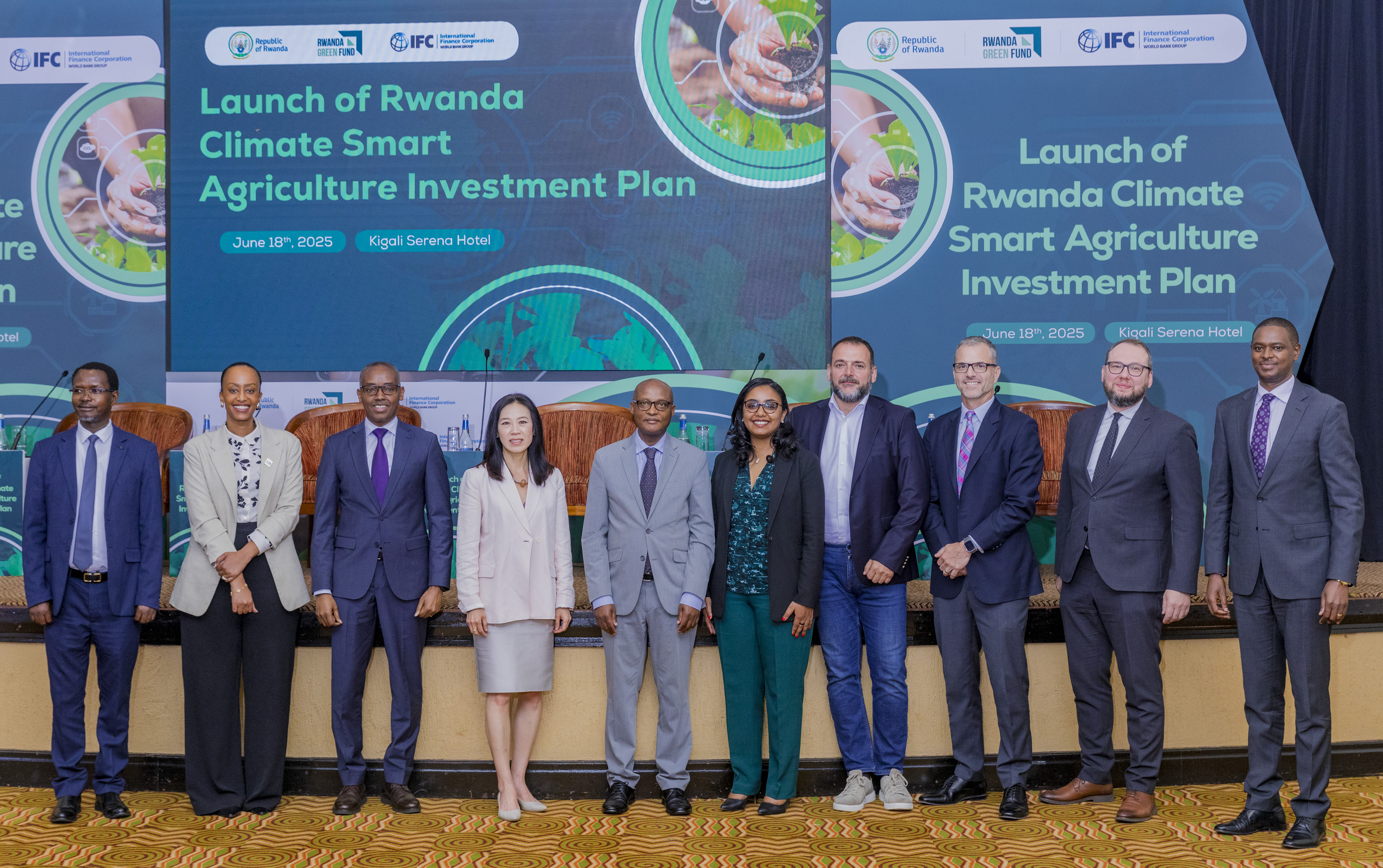
Today (June 18th, 2025), the Ministry of Agriculture and Animal Resources (MINAGRI), and Rwanda Green Fund, in collaboration with International Finance Corporation (IFC), launched Rwanda Climate Smart Agriculture Investment Plan (CSA-IP) in Kigali.
In the longer term, the plan aims to scale and mainstream climate smart agriculture investments by securing additional funding, expanding investment opportunities, and implementing policy reforms.
During the launch event, the Minister of MINAGRI, Dr. Mark Cyubahiro Bagabe, emphasized that the plan aims to attract investment particularly from the private sector to make our agriculture more climate-resilient, productive, and sustainable.
He added that this CSA Investment Plan aligns with Rwanda's Strategic Plan for the Transformation of Agriculture (PSTA5) which aims to accelerate agricultural transformation through increased climate resilience, productivity, market access, and private sector investment, with the overarching goal of ensuring food security, economic growth, and improved livelihoods.
“This CSA Investment Plan has been designed to address the pressing challenges Rwandan farmers face daily such as unpredictable rainfall, water scarcity, declining soil health, post-harvest losses, and the urgent need for climate adaptation,” Minister Bagabe said.
The Chief Executive Officer of Rwanda Green Fund, Mrs. Teddy Mugabo, said that this CSA Investment Plan serves as a roadmap for mobilizing investment to support climate-resilient and sustainable agricultural practices and put in place supportive regulatory frameworks.
“This strategic initiative enables us to mobilize climate finance at scale, reinforcing Rwanda’s commitment to sustainable agricultural development and private sector engagement,” she said.
The plan anticipates supporting about 83,250 hectares of land to become more resilient and productive through efficient water use, higher-yielding crops, and enhanced soil health. It suggests linking an estimated 170,200 farmers and 375 companies to climate smart financing through bankable investments, fostering long-term business relationships.
IFC’s Resident Representative for Rwanda, Mrs. Jiyeon Janice Ryu highlighted that this investment plan provides a national-level strategic framework to prioritize private sector-oriented climate smart agriculture investment opportunities, identify financing mechanisms, and propose key actions for the government to achieve meaningful impact.
Rwanda's agriculture sector is crucial to the country’s food security and economic growth. However, the sector is vulnerable to climate change, including unpredictable rainfall, increased temperatures, prolonged droughts, and soil erosion, which are threatening crop yields and livestock productivity, jeopardizing rural livelihoods.
Developing climate-resilient, productive, and modernized agri-food systems is a central focus of Rwanda’s National Strategy for Transformation (NST2), which seeks to increase private investment in the economy from 15.9% of GDP ($2.2 billion) to 21.5% ($4.6 billion).
According to the launched Climate Smart Agriculture Investment plan, about two-thirds of the total investment opportunity will be in water supply and irrigation, with additional opportunities in climate-resilient planting and replanting, post-harvest, loss reduction, climate-resilient livestock development, and enhanced soil health.
END.
Topics

Rwanda held its third National Seed Congress bringing together actors in seed sector

Rwanda hosted Africa Food Systems Forum 2026

19th Rwanda Agricultural Show Concludes with Record Participation and Recognition of Agricultural Innovation

Rwanda Agricultural Show 2026: Stakeholders urged to leverage innovation and strategic partnerships for agri-food systems transformation
RWANDA’S AGRICULTURE SECTOR TRANSFORMATION OVER THE LAST 32 YEARS
Rwanda launched Green House Crop Insurance to boost climate-resilient agriculture

Rwanda to hold third National Seed Congress bringing together actors in seed sector

MINAGRI YIBUTSE KU NSHURO YA 32 ABARI ABAKOZI BAYO BAZIZE JENOSIDE YAKOREWE ABATUTSI